
At a glance: For patents related to S/W, business models, and IT, many are deemed abstract ideas and often face difficulty in registration because patent eligibility under §101 of the U.S. Patent Act is not recognized. technical improvement and an unconventional additional element, i.e., significantly more, are required for patent protection in the United States. Since the 2014 Alice decision, USPTO examination guidelines (2019 PEG and 2024 AI Guidance) and court precedent have changed significantly.
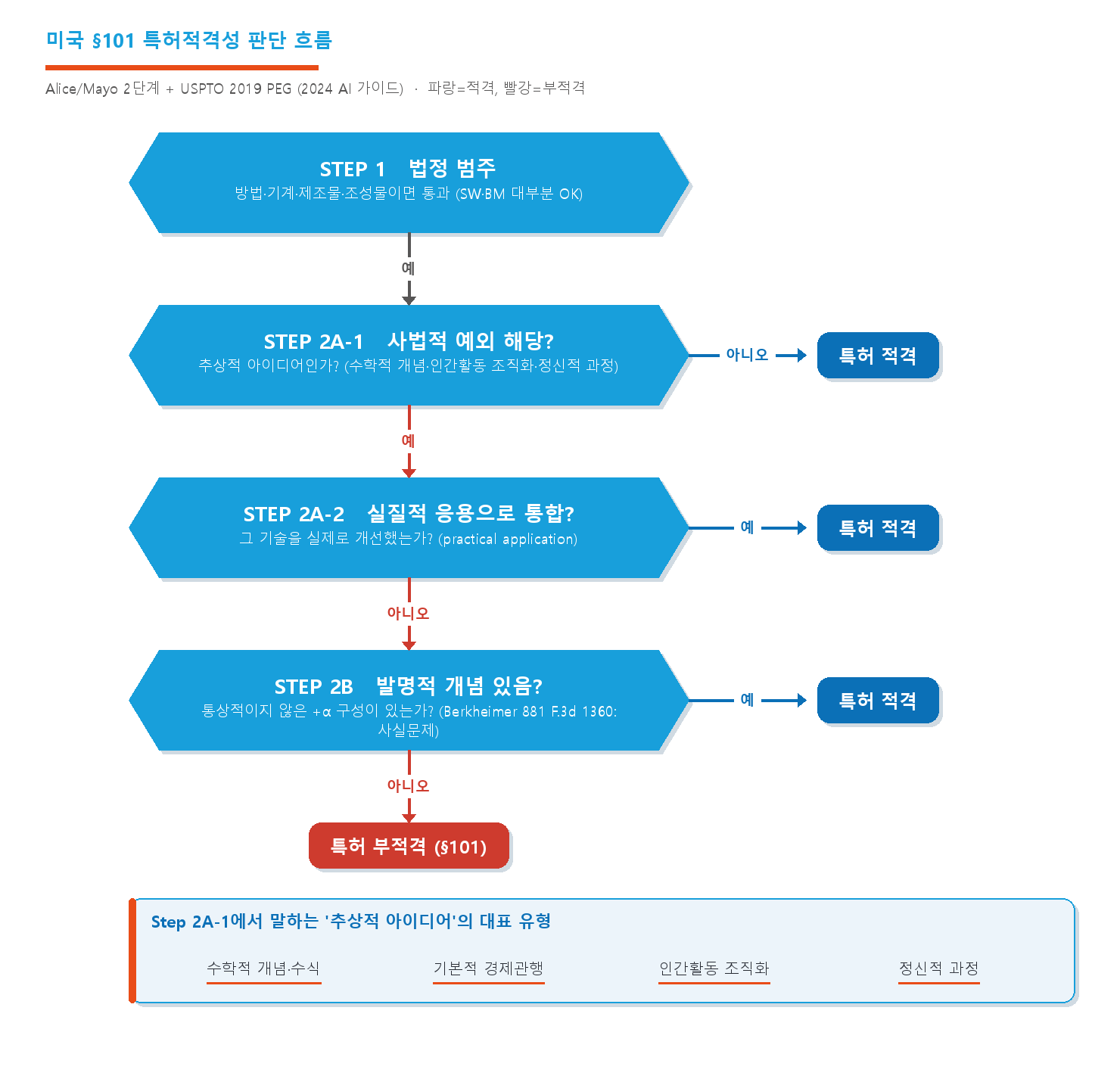
1. §101 Analysis Flow
2. Case Law and Guidance Trends (2014–2026)

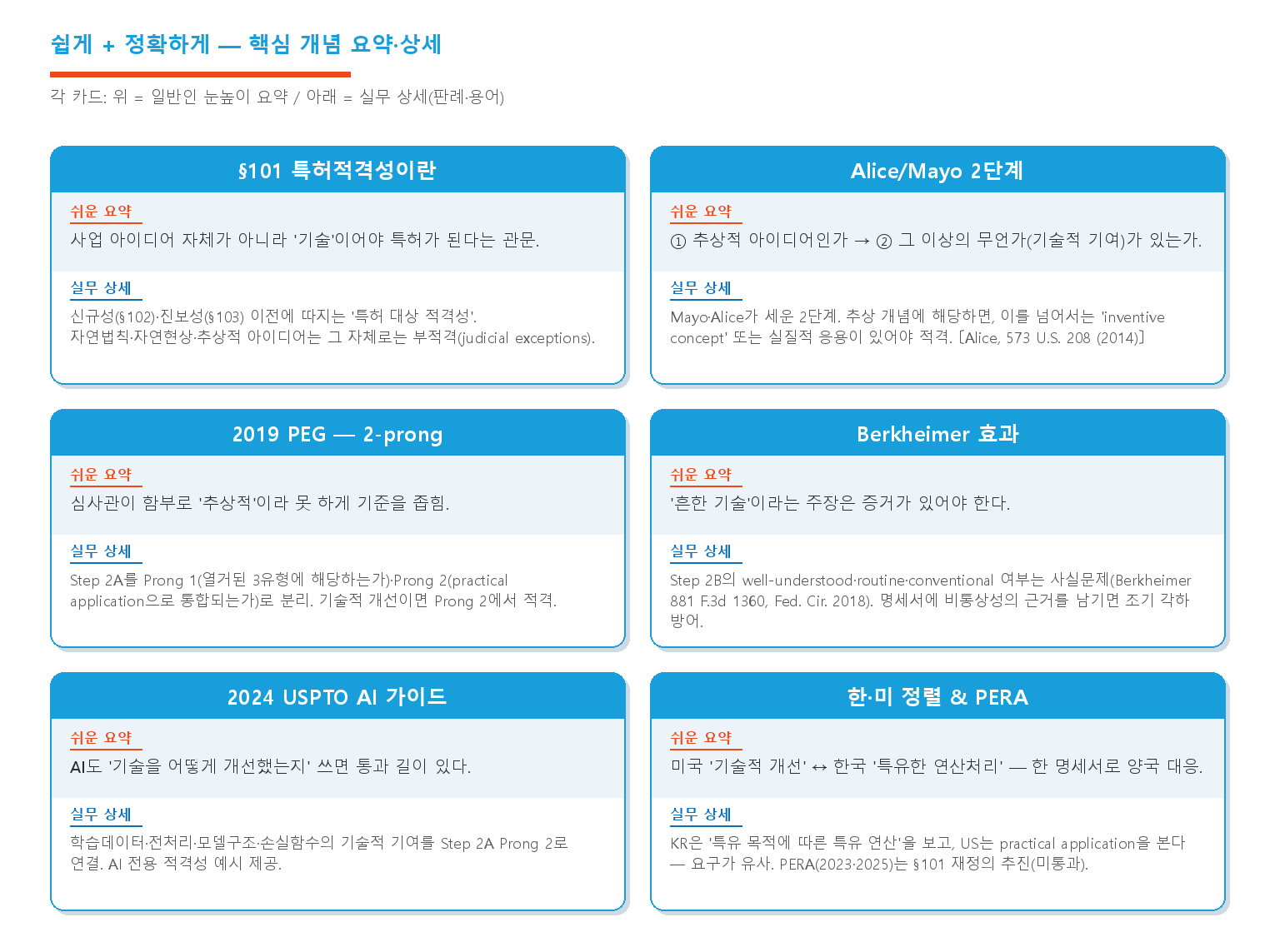
3. Key Concepts
4. Implications
- The examination threshold has been lowered — The USPTO expanded recognition of “technical improvement (practical application)” through the 2019 PEG and 2024 AI Guidance.
- However, litigation remains strict — Courts (CAFC) continued to find most §101 merits cases ineligible in 2024, with only a very small number found eligible.
- AI inventions should be drafted in line with the 2024 Guidance — Technical contributions in training data, preprocessing, model architecture, and loss functions should be connected to “technical improvement.”
- Coordinated response in Korea and the United States — The U.S. requirement of “technical improvement” and Korea’s requirement of “specific computational processing” are similar, allowing one specification to address both jurisdictions.
- Monitor legislative changes — If PERA (2023/2025) is enacted, the §101 standard itself may change.
5. Treatment in Korea
At a glance: Korea follows the same direction: protection is not for software or BM ideas themselves, but requires implementation of “specific information processing” in combination with hardwareto be recognized as an invention. In March 2019, the Korean Intellectual Property Office revised its examination guidelines to reflect the reasoning of the U.S. Alice decision.
- Establishment of an invention — A computer program itselfis not an invention; software must be combined with hardware to construct a “specific information processing device according to the intended use or an operating method thereof”to qualify as an invention.
- Inventive step — Limitations such as simple information transmission, input/output relationships, specifying information types, “if-then” logic, or simple condition settings carry little weight. Specific computational processing must be presented, and distinctiveness in computational processing (difficulty of configuration)must stand out to increase the likelihood of registration.
- Claim Format — In addition to method and apparatus claims, a “program stored on a computer-readable recording medium”(medium claim) format is recognized.
- AI Inventions — Under the Korean Intellectual Property Office’s examination guidelines for the artificial intelligence field,technical features such as training data, preprocessing, and model architecture must be specifically described.
Comparison with the United States: The U.S. “technical improvement (practical application)” and Korea’s “specific information processing and difficulty of configuration” look to substantially the same point. Therefore, a strategy of using one specification to address both Korea and the United Statesis effective.
Basis: Korean Intellectual Property Office, “Examination Guidelines for Computer-Related Inventions” and “Examination Guidelines for the Artificial Intelligence Field” (revised March 2019, reflecting Alice) / Patent Act Article 2 (definition of invention) and Article 29 (novelty and inventive step).
Sources
- Alice Corp. v. CLS Bank Int’l, 573 U.S. 208 (2014)
- DDR Holdings v. Hotels.com, 773 F.3d 1245 (Fed. Cir. 2014)
- Enfish v. Microsoft, 822 F.3d 1327 · BASCOM v. AT&T Mobility, 827 F.3d 1341 · McRO v. Bandai Namco, 837 F.3d 1299 (Fed. Cir. 2016)
- Berkheimer v. HP, 881 F.3d 1360 · Aatrix v. Green Shades, 882 F.3d 1121 (Fed. Cir. 2018)
- American Axle v. Neapco, 967 F.3d 1285 (Fed. Cir. 2020); cert. denied (2022. 6. 30.)
- USPTO 2019 Revised PEG (2019) · 2024 Guidance Update, Fed. Reg. (2024. 7. 17., FR Doc. 2024-15377)
- USPTO “Adjusting to Alice” (Office of the Chief Economist, 2020) — statistics showing an approximately 25% decrease in first §101 rejections
- Patent Eligibility Restoration Act: S.2140 (118th Cong., 2023) · S.1546 (119th Cong., 2025)
※ This content is general information, and individual matters require consultation. · MyStar24 Patent & Law Firm